France in revolt: a French student’s account:
It’s the state that wields the real violence ― ‘insurrection is the most sacred of rights’
〈노동자 연대〉 구독


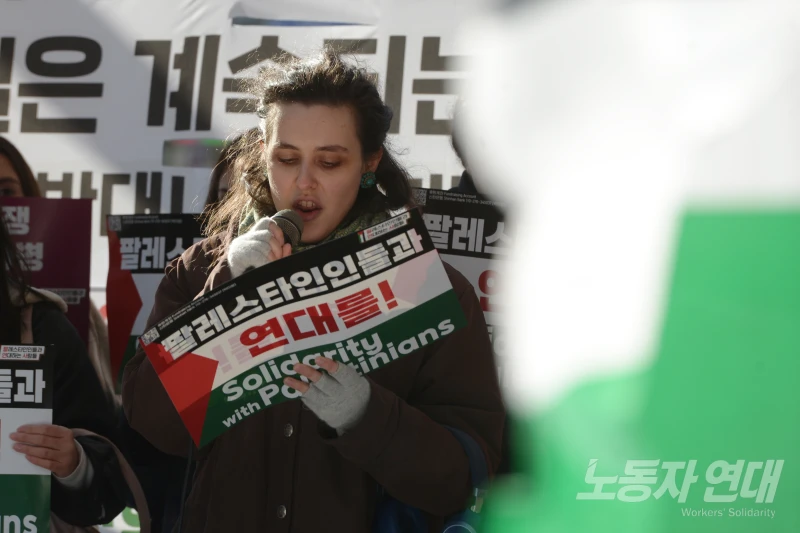
Laure Mérel is a master’s student researching colonial history and modern Korean history at the National Institute for Oriental Languages and Civilisations (INALCO) in Paris, France. While studying world history and Korean history, she began to question why France’s own history of colonial rule receives so little attention in French society. Her research interests include the relationship between colonialism, imperialism and capitalism, as well as the formation of nations. She is a supporter of the French left-wing party La France Insoumise (LFI) and a member of its action group in Seoul.
Ever since the start of the school year in France, a high school student-lead movement has been shaking the country, joined then by university students and by a large part of the wider social movement. This mobilization is following on from protests happening in other countries, inspiring young people to mobilize worldwide.
In this article, I will try to explain where the anger comes from, what the movement is demanding, how it is organized, how the State is responding, and what we can expect from it. The figures quoted are those available to us in mid-November 2026, and they change almost every day. They are sourced, but they sometimes come from estimates, because the government remains opaque about the data on the ongoing demonstrations.
1. Where the anger comes from
First, a word about schooling in France. It is historically based on free public schools: 82% of pupils, from primary school to high school, attend a public institution in 2026. But the private sector is growing, especially at the high school level, where it reaches 21%, as the State reduces its investment in education.
The movement did not start in Paris, but in the overseas territories of France, that are remains of the colonial era. On August 31 of this year, in Mayotte, students blockaded the Nord Highschool. Parents and teachers joined the strike to denounce unacceptable conditions: the school has been in disrepair since Cyclone Chido, which devastated the island in 2024. In the overseas territories, the problems are even more severe: heat all year round with no air conditioning or fans, buildings that deteriorate faster in the tropical climate, teachers who are not replaced, and poor public transport to get to school. This is the legacy of colonization: these territories are still neglected by mainland France today. And even within the movement, very little has been said about the fact that it all began there. It is not the first time: back in 1967, an uprising led by workers in Guadeloupe had already preceded the insurrection of May 68 in mainland France.
On the mainland, the spark came on September 21 in Créteil, in the Paris suburbs, with the blockade of the Saint-Exupéry High school. Then the movement spread across the whole country.
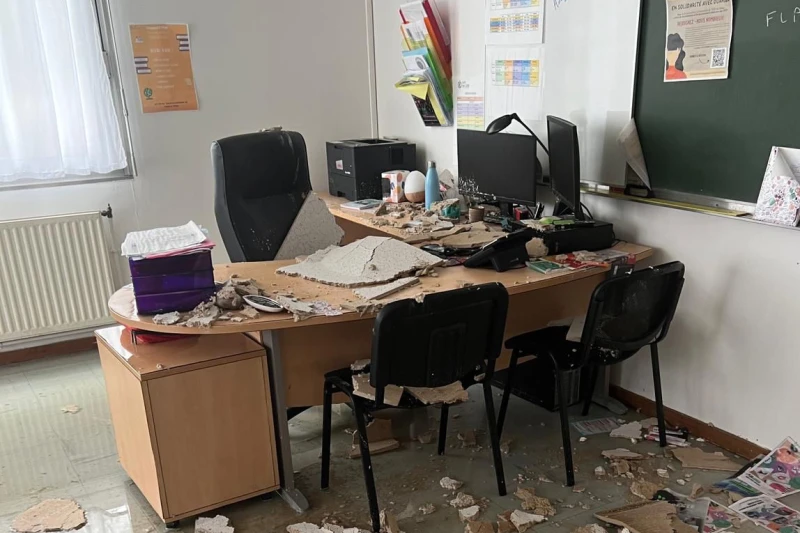
So what is exactly the situation of high school students? First of all, classes are overcrowded, with not enough desks and chairs for all the students, making for very poor studying conditions. Indeed, there are not nearly enough teachers, and no substitutes when they are absent : 10% of class hours are not taught each year and one in every two schools was missing a teacher at the beginning of this school year. I myself spent more than six months in high school without a history class, even though we were supposed to take the baccalaureate exam at the end of the year. There aren’t enough social workers or school nurses either. In some schools, no toilet paper nor soap is provided, and many buildings are unsanitary, with rats and cockroaches crawling in the corridors, water leaks, ceilings that are falling. No heating in winter, no air conditioning in summer, especially as France has gone through the worst heatwave since we began measuring temperature, killing 8000 people this summer. In consequence, 2000 schools had to close in June and 10 000 out of a total of 60 000 had to change their hours for several days due to extreme temperatures, often over 40 degrees celsius. This also affected the exams like the baccalaureate that are traditionally taking place at the beginning of the summer.
But behind these terrible material conditions lies a deeper question: the ideology that shapes the school. The high school reform a few years ago introduced a customizable system with an enormous number of specialization subjects, hence badly organized timetables and very long days with gaps between classes. The baccalaureate reform added continuous assessment on top of that, so that all the grades you get in high school count for you to get your diploma, which is very stressful for students. This resulted in the rise of competition everywhere, the destruction of the class as a collective, and hyper-individualized education where everyone builds a portfolio of skills. It is neoliberal ideology implemented in education, backed by European Union texts on education policy: the goal is to produce individuals who are adaptable, flexible, versatile and employable in a world of permanent instability. We are thus giving up on training critical and creative minds, which used to be the goal of the French schooling system.
And at the end of high school, there is Parcoursup, the platform that sorts students for admission to higher education. It discriminates according to the student’s school of origin, and it selects in absurd ways: someone was accepted into a program after putting a cookie recipe in place of a cover letter. Above all, there are not enough places for everyone: in 2026, 18% of applicants, more than 100,000 people, received none of the offers they had applied for. Passing the baccalaureate used to give you access to enroll in any university degree you wanted, but not anymore. This shortage is organized, for the benefit of the explosion of private schools. It is an attack on the public university, a place of collective knowledge-building and critical thinking, and a counterpower that escapes the commodification of knowledge wanted by neoliberals. The competition continues afterwards for the master’s degree, which is essential for many jobs in France, and then for the doctorate.
2. The demands
The material demands, that is, the minimum conditions to be able to study, go hand in hand with political demands: social justice, equality, a decent education system for everyone, with the same opportunities whether you are in the overseas territories, in the banlieue or in the heart of Paris, in a private or a public school. The neoliberal rhetoric permeating French society tells them again and again that they will succeed if they work hard enough, but high school students can see very well that this is not true, that they are not fighting on equal terms. Hence the anger.
The student movement has adopted a program through the Union Etudiante (Student Union), the largest student union in France. This so-called “ten-point emergency plan” has been signed by more than 100,000 people, and most French people support it according to polls. The ten points are: renovating school buildings; hiring education, health and guidance staff on a massive scale; rethinking school schedules so that they better respect, among other things, the biological rhythms of teenagers; abolishing Parcoursup (the platform that sorts access to higher education) and Mon Master (the platform for access to master’s programs), and creating 250,000 places in higher education; overhauling high school democracy; raising scholarships and housing aid; guaranteeing the one-euro meal for all students; repealing the differentiated tuition fees for international students and abolishing the university enrollment tax; freezing rents in student residences and building them on a massive scale; putting an end to repression and police violence against the movement.
3. Forms of action and scale
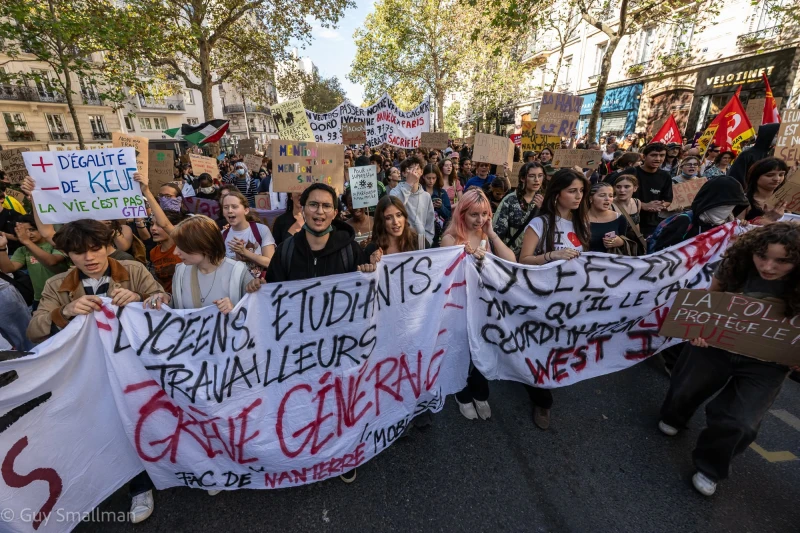
The heart of the movement is the blockade of schools: while some accuse them of being lazy and not wanting to go to class, students show up every day at six in the morning in front of their high school or university to block the entrance.
In October, between 10 and 33% of high schools and up to 90% of universities were fully blocked or closed as a precaution. The blockades even reached traditionally conservative institutions, such as Assas law school or HEC, the most prestigious business school in the country. This shows a real solidarity between the most privileged and the most neglected high school and university students.
General assemblies are held in front of high schools and in universities to consult the students about their specific demands for the school they are attending and deciding what to take the mobilization next. In several blockaded universities, students set up people’s universities: they organize lectures, workshops and a pay-what-you-want canteen, open to all, with a program decided by the students.
Outside, after the first instances of police violence, parents, education staff and elected officials from La France Insoumise (France Unbowed) came to stand between the young people and the police to calm the situation. Young people organize themselves with safety instructions for demonstrations and legal advice in case of police custody, widely shared on social media, stressing the importance of filming every confrontation with the police so that the footage can be distributed and complaints filed if things get out of hand. On top of this, there are demonstrations every Saturday and actions and strikes during the week: 800,000 people in the streets on October 17, 1.6 million during the November 5 strike, and regularly between 100,000 and more than 200,000 every Saturday.
4. Humor, creativity and republican hope
But this movement is not only anger. It is also a struggle through humor, creativity and the joy of being together. Throughout the protests, blockades and social media, we can see inventive signs, costumes and disguises, songs and music, and “aura battles” (those humor contests that come from the internet). This generates enthusiasm and the support of most of the population, and it helps the demonstrators not to sink into depression in the face of repression and ever harsher living conditions. For example, one of the slogans of the demonstrations, “bismillah c’est les ténèbres” (roughly, “in the name of God (in Arabic), it’s darkness”), comes from a message by a police officer who had infiltrated a Snapchat conversation among high school students and tried to imitate the way young people speak in order to get information about the blockades. Another phrase often heard is “condolences to the bereaved families of the trash cans”, denouncing the fact that the government seems to care more about trash cans burnt during the demonstrations than about its own population, which it abuses every day.
There is also a very strong political dimension to this mobilization. The high school students want to fulfill an emancipatory, democratic and social Republic. They are reclaiming all the symbols of the French Republic: the Marseillaise (French national anthem), the motto “liberty, equality, fraternity”, and even the French flag which they take back from the nationalist right and far right. The young people insist on being part of the same France, on all being French, against the relentless attacks of those who want to divide them. They also claim to be heirs of the French Revolution.
The political maturity of this youth, its ability to express itself in the media, is indeed impressive. In an interview, a high school student said she did not want to become “cannon fodder or boss fodder”. Despite her young age, she is thus aware of the prevalence of the military-capitalist complex that our governments are trying to impose on us, and she refuses it.
5. Repression and the authorities’ responses
The government’s first response was to discredit young people, saying they are lazy or manipulated by the ultra-left or by La France Insoumise.
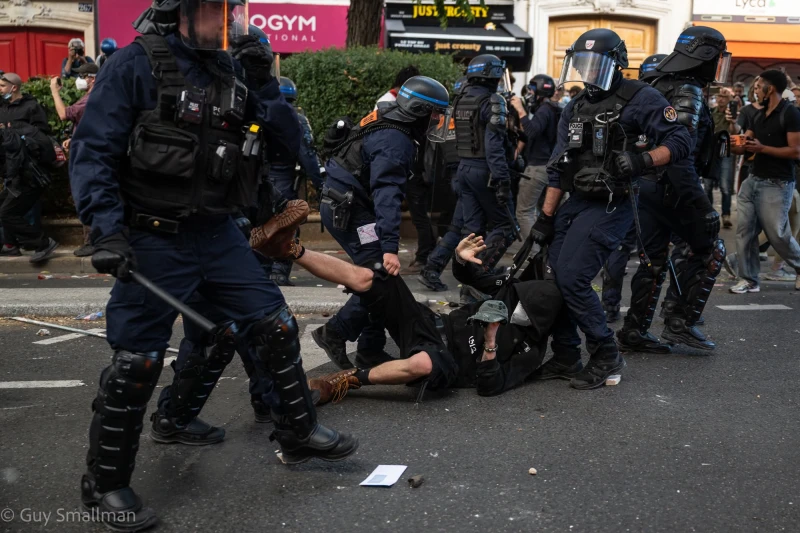
At the same time came the repression, as intense as during the Yellow Vests’ revolt in 2018, and severe violations of the rule of law. For example, police uses tear gas massively during protests, including on children, on elderly people, inside shops and even in private homes. France is indeed the European champion in the use of tear gas for policing. Tear gas causes breathing problems, burns the eyes and skin, and many testimonies report severe menstrual disorders among women, several women even reporting having experienced a miscarriage after being exposed to it. At the same time, masks, goggles and saline solution to protect oneself from it are banned and confiscated. There are also shots from defensive ball launchers (LBD), kettling (blocking demonstrators before charging them with batons), vehicles driven into crowds, the use of water cannons, sound weapons, light shields to prevent filming, and the police have even entered universities several times.
The human toll is heavy: about one hundred people maimed, many of whom are underaged, as recorded by an independent journalist, because the government provides no statistics on injured demonstrators: 11 people who lost an eye, 18 serious cranio-facial traumas, 7 amputees, and at least one death, after a cardiac arrest linked to gas inhalation. The real figures are probably much higher. Despite numerous reports to the IGPN, the police unit in charge of investigating the police, very few cases go anywhere because the IGPN is not independent, which guarantees near-total impunity for police officers.
Indiscriminate searches are often conducted, during which there have been reports of sexual assaults. Freedom of information and freedom of speech have also been violated on multiple occasions, with the police targeting journalists during protests and blockades, and confiscating signs they didn’t like, especially those containing anti-police slogans like “ACAB (All Cops Are Bastards)”.
The repression is also judicial and administrative. About 8,000 people were taken into police custody in the first month of the movement, 85 to 90% of them minors, about twice as much as during the first month of the Yellow Vests’ protests. Detention conditions are often unacceptable: young people report having had nothing to drink or eat for hours, sleeping on the floor without a blanket in the cold, being refused a lawyer or a doctor, being stripped and held in their underwear, and even homophobic and racist insults. High school students who speak up during blockades face house searches, anti-terrorism laws are used to put them under house arrest to prevent them from demonstrating, and mass registration in police files is widespread. After the arrests of October 17, the Minister of Justice Gérard Darmanin gave prosecutors instructions to request prison sentences in immediate trials, going against the separation of powers. Moreover, most police custody cases lead to no prosecution at all: the goal is therefore clearly to scare high school students into stopping their actions.
An opinion column written by representatives of public officers and magistrates and published on November 17 in Le Monde newspaper denounces an instrumentalization of justice by the government to repress the protests and the worst civil liberties’ repression since the end of the colonial wars. Indeed, Emmanuel Macron said it himself during one of his speeches: there are protesters who are legitimate in their right to protest, and “some who have no legitimacy”.
6. October 17 and the convergence of struggles
In response to the movement, the government first resorted to provocations, announcing job cuts in education. It began to shift on October 8, by putting a platform online, a sort of book of grievances, and promising 3,000 substitute teachers. Then came October 17, which shook things up.
That day, the students were joined by the Yellow Vests, the wage-earners’ unions like CGT and the Confédération paysanne (the small farmers’ union). The call to demonstrate, widely shared on social media, invited people to march all the way to the Élysée Palace. The Interior Ministry completely underestimated the mobilization: it first announced 10,000 police officers across France, a figure later corrected to 60,000, whereas 80,000 had been deployed in Paris alone for the Pope’s visit in September earlier this year. Its strategy of blocking the marches when they arrived broke the demonstrators up into a multitude of small processions in every city. The result: looted and wrecked shops, damaged official buildings, the town hall of Limoges burned down, many injured and one death among the demonstrators.
The Interior Minister Laurent Nunez offered his resignation, which Macron refused. Above all, the repression hardened: censorship of social media, TikTok in particular, curfews, police custody for left-wing influencers, demonstration bans in many cities, often overturned by the courts, and demonstration routes changed at the last minute so as to arrest and harass those who do not follow the “right” itinerary.
It was also at this point that Macron spoke publicly for the first time and that the first concrete political responses to the movement’s demands came: notably, the replacement of Parcoursup in 2028 after an overhaul in 2027; between 1,700 and 1,900 teaching posts created; a cap of 28 students per class in the second year of high school; 15,000 additional places in higher education (against 250,000 places demanded); scholarships raised in line with inflation; 4 billion euros spread over several years to renovate high schools, concentrated on priority schools (which do not even include the school where the movement started on the mainland); and 1 billion for the university (against 10 billion euros demanded immediately by the students). The students’ representatives judged the government’s proposals very insufficient and vague because it did not go into details as to how it would implement and finance such measures.
From then on, the social struggles fed from one another and kept converging: against the high cost of living, for higher wages, for support for young people, for the defense of civil liberties, against the far right, against police violence.
7. Media, the far right and criminalization
The media coverage of the high school movement uses the government’s rhetoric. The left is criminalized, La France Insoumise (LFI) in particular: it is accused of encouraging the blockades and the violence, and leaders on the right call for its dissolution. An intelligence commissioner revealed that his superiors asked him to write that LFI is behind the high school movement. More recently, the Prime Minister’s office suggested that LFI elected officials, unions and education staff were delivering firework mortars to students in front of high schools, without putting forward any evidence.
Demonstrators are criminalized too. According to a study, between late September and October 2026, 75% of airtime on news channels was devoted to violence and property damage, against 8% for the movement’s demands. As soon as a guest on TV mentions demonstrators who lost an eye or a hand, the figure for injured police officers is thrown back at them. Yet this figure of more than 1,200 is based on self-reporting, which includes a twisted ankle when getting out of a vehicle or a damaged fingernail: 1,167 of the so-called “injured police officers” are minor injuries. Finally, “young people from immigrant backgrounds”, a way of avoiding saying Black and Arab people, are said to be supposedly behind the violence in the demonstrations, which is backed by no facts. In response, demonstrators heckle or refuse to speak to the TV reporters from channels like CNews and BFMTV that spread xenophobic discourses. These reporters thus sometimes resort to hiding their affiliation in order not to be heckled. Some of these media employees are even starting to act against their management, tired of being mistreated in the field.
The far right is getting involved too. After the media framing of October 17 focused on the “small shops” that were wrecked, neofascist groups organized themselves to “protect” these shops and to help the police. In practice, they come to beat up demonstrators, often under the benevolent gaze of the police. There were also calls on social media to murder immigrants, with some people notably suggesting luring delivery workers, a precarious job often held by immigrants, to isolated places to kill them. It is in this context that a racist and Islamophobic attack took place in Trappes on October 23, to “avenge” the shopkeepers looted on October 17. It is useful to remember that the national police were created under the Vichy regime, which collaborated with the Nazis, and that it is regularly shaken by scandals of racism. Numerous studies show that it maintains a colonial relationship with non-white populations, concentrated in the poorest neighborhoods on the outskirts of large cities.
8. Who is violent?
The violence by demonstrators is very marginal, and mostly directed at material property: trash cans, bus shelters, shop windows. Yet many of the demonstrators interviewed do not condemn this violence. They defend it as a form of action, because they say that it is the State that is brutal: setting fire to a trash can or breaking a window seems trivial compared with the social, class and institutional violence they live with every day. Their anger is aimed at the leaders rather than at the “rioters”, because they are convinced that the real wreckers are in government: wreckers of public services, of education, of hospitals, of the system of wealth redistribution, and of the meritocratic dream they were promised.
Indeed, nearly 10 million people live below the poverty line in France, more than 15% of the population, the highest rate since statistics on the subject began in 1996. Inequalities are also the highest in thirty years, because of the explosion of the highest incomes, as France is the second country in the world to give out the highest dividends to shareholders, after the United States. Meanwhile, budget cuts worsen the lives of millions of people, even resulting in the death of many of them as the public hospital has been in crisis for years. The State apparatus, police and justice, on their end, are marked by institutional racism.
Above all, French citizens have tried every other path since 2017 to have their voices heard. The grievance books of the Yellow Vests and the proposals of the Citizens’ Convention on Climate of 2018 were not implemented. Millions of people demonstrated against the pension reform in 2019, with no response. The left won the legislative elections in 2024, but three right-wing Prime Ministers followed one after the other. The petition against the Duplomb law, which reintroduces dangerous pesticides, gathered 2 million signatures in 2025, but the law passed anyway. After the Islamophobic attack in Trappes, a million signatures called for the closure of CNews, the far-right propaganda channel of French billionaire Vincent Bolloré, but the petition was filed away without being discussed in the National Assembly. While neoliberalism attacks the very conditions that make life on earth possible by destroying the environment, it also attacks humans’ livelihood directly by being especially harsh to those of us who are the most vulnerable, like children and the elderly. Children because they are dependent on others to survive and do not have voting rights yet, the elderly because they are at the end of their lives. Hence the neverending attacks on education and on the pension system.
The only ones to have won concessions were the Yellow Vests, with 10 billion euros given out by the government for purchasing power, through blockades and forms of action that were deemed violent. And once again, with the high school movement, the government only responded politically after the most violent day. Indeed, neoliberal leaders like Macron believe that brave political figures ought to govern against their people, because they are convinced to be the only ones who get the issues at stake, while the people are too idiotic to understand their grand schemes. Faced with all this, the UN and Amnesty International have expressed their concern on an authoritarian turn of the French regime. The government, for its part, has not had a single word of regret for the hundreds of injured among the demonstrators, and speaks of a “proportionate response”.
9. Outlook and conclusion
Where do we stand today? 30 to 40% of high schools are still affected, and at least a third of universities remain blockaded. The government is downplaying these figures and trying to make people believe the movement is gradually ending. Yet tens, even hundreds of thousands of people continue to march every Saturday, with 500,000 demonstrators taking to the streets after the unions’ call to strike on November 17.
A political outlet is emerging with the presidential election of April 2027, but there are still five months to hold out against a government that does not seem willing to give anything up. Many talk about maintaining the mobilization until these elections. Will the government last until then? To add insult to injury, the police union demonstrated unauthorizedly on November 18 to demand an increase in their hazard pay. They could reach the presidential palace and the prime minister’s palace undisturbed. After a ridiculous 34-minutes protest, they could meet with the Prime Minister and their demands were met. More money to continue the repression of protesters.
I will conclude this article by quoting the Declaration of the Rights of Man and of the Citizen of 1793, which the demonstrators have taken up. Article 34: “There is oppression against the social body when a single one of its members is oppressed. There is oppression against each member when the social body is oppressed.” Article 35: “When the government violates the rights of the people, insurrection is, for the people and for each portion of the people, the most sacred of rights and the most indispensable of duties.”